
Adam Pendleton doesn’t shy away from posing charged questions. “Who Is Queen?” he asked within the Museum of Modern Art’s soaring Marron Atrium during his breakout 2021 exhibition of the same name, where monumental scaffolding towers supported the Brooklyn artist’s frenetic and technically rigorous paintings. Often layered with gripping text fragments and marked by expressionistic flourishes, Pendleton’s abstract canvases immerse viewers in the cacophony of contemporary life and spark visions of a different future. His latest show takes that inquiry into new territory and raises another pointed question: What happens when one of today’s most celebrated artists shifts his focus to furniture?

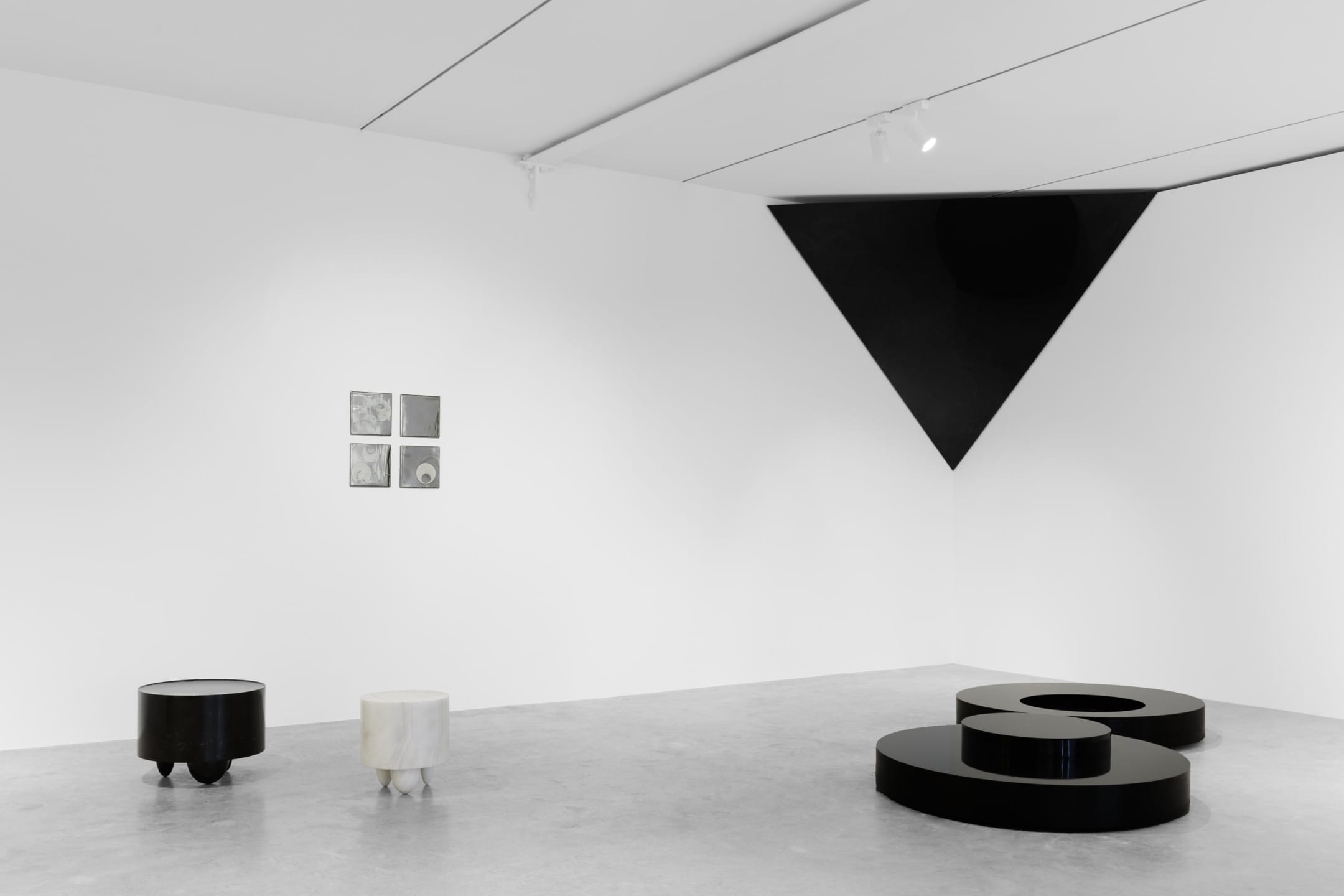
At Friedman Benda, he answers that question with a clear vision. In “Who Owns Geometry Anyway?” on view through December 19, Pendleton debuts a series of tables alongside a ceramic painting and two wall works that extend the visual language of his broader practice. “I’ve had ideas about how to translate the geometries I use in my paintings and drawings into functional forms for many years,” he tells Galerie. “I’ve just never permitted myself to follow through on them.” He felt the moment arrive after realizing sculptural components for several recent shows, including the scaffolding towers from his star-making solo presentation at MoMA. “Function introduces a different kind of intimacy,” he explains, “a way for form to be activated by touch, by use.”
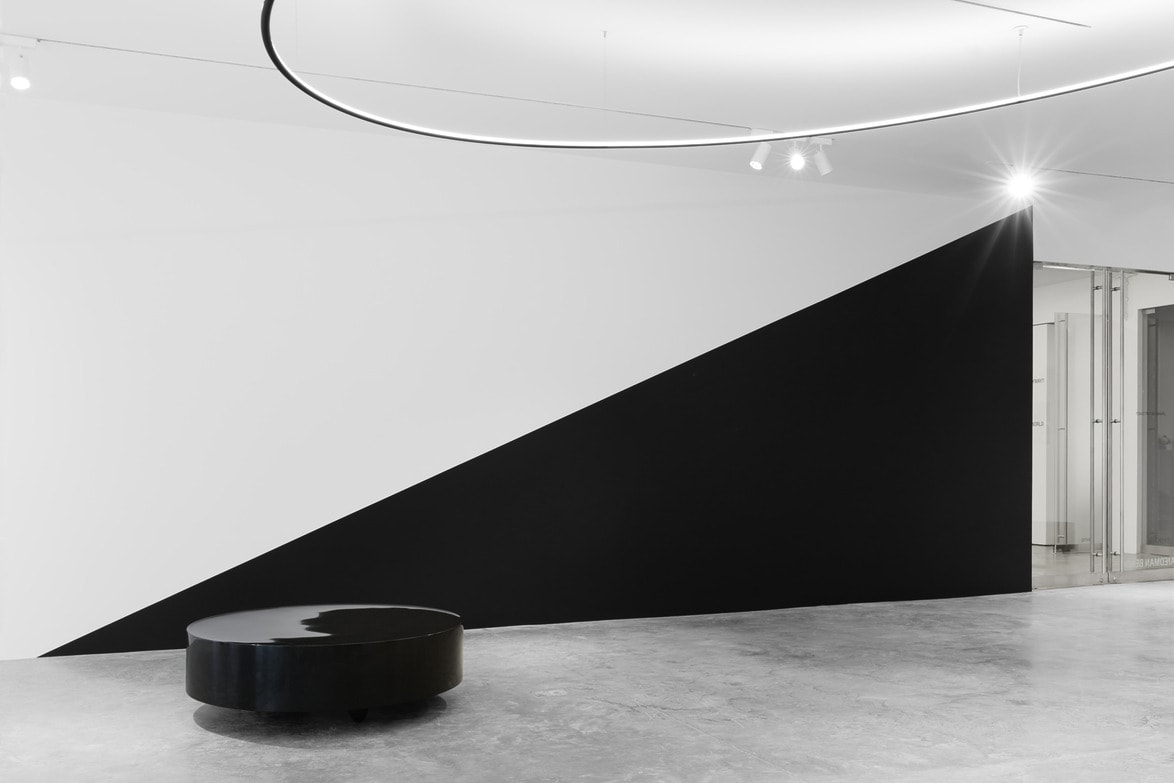
Photo: Izzy Leung. Courtesy of Friedman Benda and Adam Pendleton
Pendleton heightens this sense of intimacy through soft, approachable shapes. Circles are familiar terrain for him, though exploring them volumetrically brought fresh challenges. “Geometry has always been a point of departure for me,” he admits. “Here, circles, and voids had to hold weight, cast shadows, and frame space.” A giant aluminum light presides halo-like in the gallery, its exact contour reflected in furnishings such as onyx and black marble tables with feet that taper into smooth curves. The rough-cut sides of a stone-like piece counter its sliced, polished tabletop. Material removed from a central circular void reappears as a separate table nearby, presenting absence as substance; the two pieces interlock visually. “These materials have deep histories, densities, and a specific sense of gravity and weight,” Pendleton says. “Each material anchors the forms while keeping them open and contingent.”
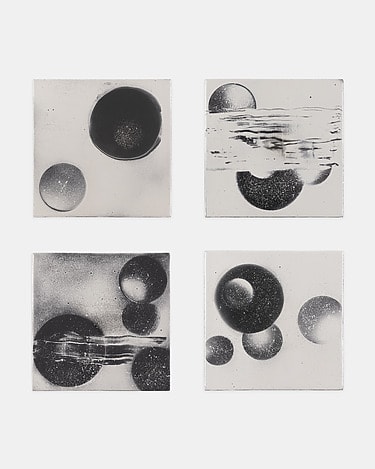
Photo: Izzy Leung. Courtesy of Friedman Benda and Adam Pendleton
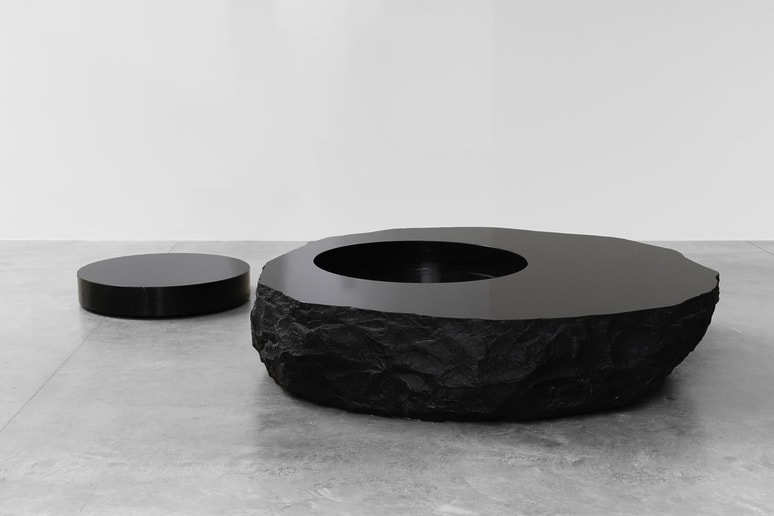
Photo: Izzy Leung. Courtesy of Friedman Benda and Adam Pendleton
He approaches installation with the same rigor. Pendleton painted hard-edged, glossy black triangles and a stark white square directly on Friedman Benda’s walls, framing the exhibition as an architectonic environment with a nod to Sol LeWitt: “sharp but permeable,” he explains. “The space doesn’t simply host the work—it participates in it, forming a porous environment where objects and architecture speak to one another.” A black triangle appears to point directly into the void of a nearby table. Wall works depicting energetic circles ricochet with the rotund base of an adjacent object. The placement recalls Isamu Noguchi’s well-known conviction that “art should become at one with its surroundings.”
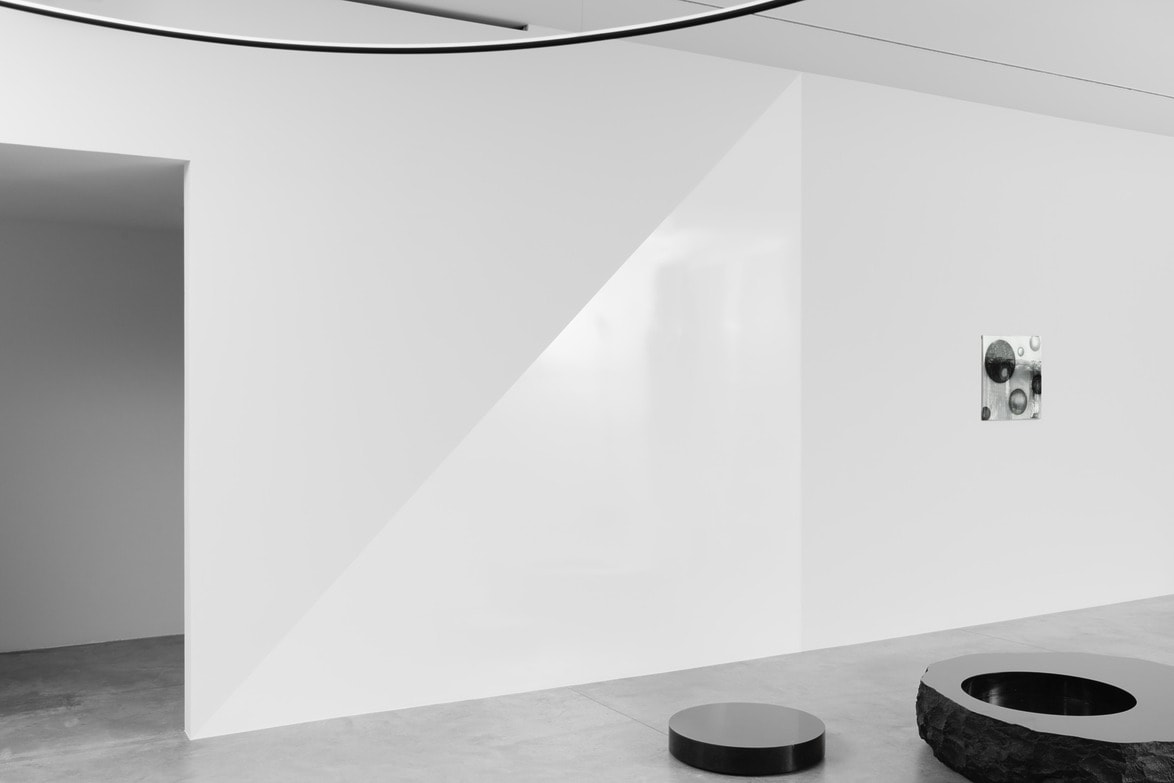
Photo: Izzy Leung. Courtesy of Friedman Benda and Adam Pendleton
Pendleton approaches this shift toward tables and sculptural objects as another way to explore how form communicates meaning. He folds circles, voids, and carved mass into a vocabulary he has advanced across paintings and drawings while asking those elements to respond to use. “Abstraction is a form of speech,” he says, and these works speak with grounded physical presence that relies on bodily encounter. “When you move around a table or see light fall through an opening, you’re encountering a kind of syntax—one that continues the same conversation my paintings and drawings have always embodied.”
link