
In simpler terms, LCA involves compiling and evaluating inputs, outputs, and potential environmental impacts of a product system from raw materials acquisition or generation to final end-of-life (ISO 14044; ISO 14040). In this study, a comprehensive LCA was performed for 25 pieces of furniture across 8 different groups, originating from 15 companies. These furniture groups and codes of furniture pieces is shown in Table 1. This analysis adhered to the methodology outlined in ISO 14044 and ISO 14040, which is structured into four main phases: (1) defining the goal and scope, (2) conducting the inventory analysis, (3) assessing the environmental impact, and (4) interpreting the results.
Method, tools and database
The LCA was executed using the Environmental Footprint (EF) method (with toxicity) and utilised the Ecoinvent 3.7 database with the cut-off system model within the Simapro 9.1 software version. This research considered all 14 environmental impact categories within the EF method defined by the European Commission, including climate change, ozone depletion, ionizing radiation (human health), photochemical ozone formation (human health), particulate matter, human toxicity (non-cancer and cancer), acidification (terrestrial and freshwater), eutrophication (marine and terrestrial), ecotoxicity (freshwater), land use, water use, and resource use (both fossils and minerals and metals).
The EF method encompasses normalisation and weighting factors, enabling the integration of impact assessments into an end point single-score result. This simplifies the presentation and interpretation of results by reducing the number of indicators required to encompass all relevant environmental impact categories. These life cycle data provide designers with actionable insights to reduce the overall environmental impact through informed design decisions. Moreover, the end-point single score results account for the interactions and trade-offs among different environmental impact categories.
Impact values are expressed in relative percentages to aid in understanding the relative impact within each comparison group. This involves standardising a specific furniture piece, phase, or process to 100% and rescaling the impacts of other pieces, phases, or processes to correspondingly lower or higher percentages accordingly. For example, to illustrate the environmental impact of 5 life cycle stages of chair 2.2, the standardisation process is detailed as follows: first, the environmental impact (expressed as a single score) of each furniture piece/life cycle stage/material/process can be acquired by inputting all inventory data into the Simapro software; Subsequently, it is essential to decide which furniture piece/life cycle stage/material/process is the reference for calculating the standardisation factor. This allows for calculating the environmental impact of each furniture piece/life cycle stage/material/process in relative percentages.
Another critical aspect of LCA is the selection of the database and system models. This study employed the Ecoinvent 3.7 database with the “Allocation, cut-off by classification system” model. This system model applies a straightforward yet fundamental approach to distinguish between primary and secondary use stages32. Its simplicity and effectiveness have also contributed to its widespread adoption in Environmental Product Declarations (EPDs)33, further establishing it as the preferred system model for this study. However, it is essential to acknowledge the influence of database models on environmental impact values. In the cut off model, recyclable materials are cut off from the producing product system, meaning they are removed burden-free from the producing activity, and no impacts or benefits are allocated to them32. Instead, the full burdens of waste treatment is attributed to the producing activity generating the waste. Consequently, recycled materials and energy recovered from incineration become burden-free resources available for subsequent consuming activities, i.e. recycled aluminum in pre-production stage in our cases32.
Goal and scope definition
Goals
This study aims to provide a comprehensive analysis of the environmental profiles of both office and household furniture across various groups, utilising quantitative LCA methodologies. The objectives of this study are detailed as follows:
-
To build a comprehensive furniture system boundary.
-
To compare the environmental impacts across 8 furniture groups and identify the group that exhibits the highest environmental impact.
-
To assess furniture pieces within each group, comparing the environmental impacts of products with different characteristics.
-
To evaluate the environmental impact across different life cycle stages for each furniture product, pinpointing the stage that contributes the highest environmental impact.
-
To examine the environmental impact of different materials and processes within each life cycle stage for each furniture item, determining the materials and processes that incur the highest environmental impact.
-
Through these environmental evaluations and comparisons, the ultimate goals of this study are to:
-
Establish a comprehensive life cycle profile for general furniture.
-
Establish a comprehensive environmental trend that applies universally to general furniture, facilitating a broader understanding of environmental impacts across the furniture industry.
-
Identify opportunities for enhancing the environmental performance of furniture at different stages of their life cycles, offering support for decision-making, strategic planning, and priority setting in the design and redesign of furniture products.
The study aspires to advance sustainable practices within the furniture industry by meeting these objectives and promoting an eco-friendly and more environmentally conscious approach to furniture production and consumption. The research entailed performing LCAs for 25 pieces of furniture, including office and household items, across various types such as task chairs (3 cases), chairs (5 cases), stools (2 cases), sofas (4 cases), tables (5 cases), coffee tables (2 cases), storage units (3 cases), and workspaces (1 case).
Functional unit (FU)
The FU is defined as the “quantified performance of a product being assessed, serving as a reference unit in the environmental impact assessment across all its life cycle stages”36. Within the realm of furniture LCA, the focus shifts from the furniture piece itself to the function it delivers22.
The functions of furniture encompass both objective and subjective dimensions, including their aesthetic appeal and extra functionalities37. Defining a FU that considers these diverse factors poses a challenge. Nonetheless, quantifying the function offered by a furniture piece is achievable. In this study, the FU for furniture is specified as “the usage of one piece of furniture, based on a typical frequency, over a span of 15 years in an office and/or household setting.” To furnish more precise information for each group of furniture:
-
Task chair, chair, stool, table
The FU is defined as “the usage of one task chair/chair/stool/table for one average person based on a general frequency over a period of 15 years in an office/household environment.”
The FU is defined as “the usage of one 3-seat sofa/coffee table/working space based on a general frequency over a period of 15 years in an office/household environment.”
The FU is defined as “the usage of one storage with 0.8 m3 storage space for files over a period of 15 years in the office/housing environment.”
System boundary
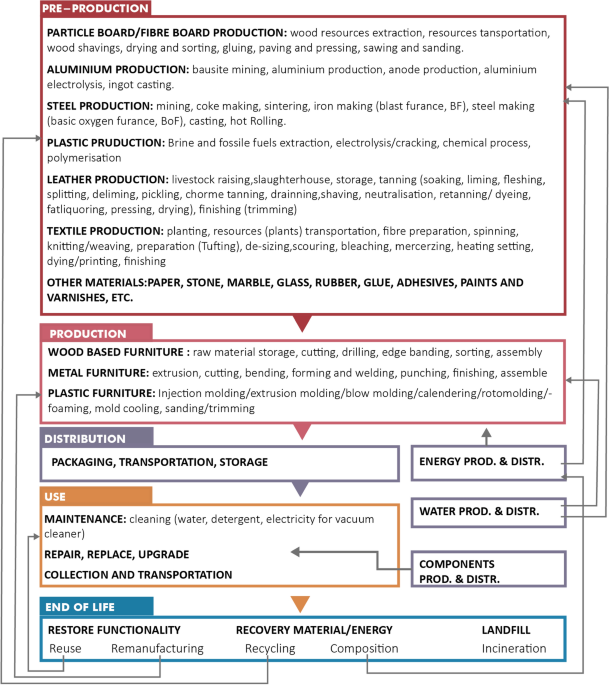
The system boundary of furniture considered within this study includes all activities (both direct and indirect) related to furniture, covering its entire life cycle from pre-production, production, distribution, use, to end-of-life, along with all pertinent processes within these stages.
-
(1)
The pre-production stage
The furniture industry utilizes diverse raw materials, including wood-based panels, metals (such as aluminium and steel), plastics, fabrics, leather, and glass6. The pre-production stage includes the environmental impacts of acquiring these raw materials, transporting them to the production site, and producing raw materials or energy required for their transformation. For example, particle board, frequently used in furniture production such as desks, tables, storage units, and bed frames, undergoes a multi-step manufacturing process. This process includes the transportation of resources and the production of wood shavings, which encompasses wood chipping, shaving, and storage. The next phase is the drying and sorting section, which involves drying, sorting, milling, and storing the materials. Following this, the gluing section includes modulating, weighing glue and shavings, and mixing. This is followed by the paving and hot-pressing section. The final phase is the sawing and sanding section, including cooling, weighing, sawing, sanding, and inspecting the boards34,35. Moreover, furniture production incorporates various other materials such as aluminium, steel, textile, leather, paper, stone, marble, glass, glue, adhesives, paints, and varnishes. When examining the pre-production phase for furniture, it is essential to apply a consistent methodology to analyse the environmental impacts and production processes of these materials, akin to the approach taken for the main materials discussed.
-
(2)
The production stage
The production stage of furniture manufacturing involves a wide range of activities essential for transforming raw materials into finished furniture pieces and their packaging. This stage includes the processing of raw materials to produce various furniture components, as well as the assembly of these components into complete items. For solid wood-made furniture, finishing processes such as polishing and painting are crucial steps that enhance the aesthetic appeal and durability of the products. Beyond the physical creation of furniture, this stage also encompasses critical activities such as furniture design, research and development, quality inspection, equipment maintenance, and overall management operations.
-
(3)
Distribution stage
The distribution phase entails transporting furniture from the manufacturing location to a warehouse or directly to the end-users via diverse modes of transportation, including trucks, trains, ships, and planes. This process not only consumes energy and generates emissions during transit but also considers the entire lifecycle of the packaging materials employed to protect furniture during transportation.
-
(4)
Use phase
The use phase centres on the environmental impacts tied to furniture maintenance, encompassing cleaning activities that consume water and detergent. Additionally, this phase includes repairing or replacing damaged parts and upgrading components, like changing the cover of upholstered furniture.
-
(5)
End-of-life phase
The end-of-life phase evaluates the environmental impacts of various furniture end-of-life treatments, including collection, delivery, reuse, remanufacturing, recycling, composting, energy recovery/incineration, and landfilling. These activities delineate the system boundaries for furniture, as illustrated in Fig. 1.

The system boundary of a general furniture product.
The subsequent sections delves into a more detailed analysis of the environmental impacts associated with these phases.
Inventory analysis
Data collection and assumption
The inventory data for this study primarily comes from Environmental Product Declarations (EPD), which are voluntary documents presented by companies or organisations to provide transparent information about the life cycle environmental impact of their goods or services. The EPDs used in this study are obtained mainly from the Norwegian EPD Foundation ( and the International EPD System (https://www.environdec.com/library?search_type=simple&Category=9492).
Some data assumptions are made based on Product Category Rules (PCR). PCRs are specific requirements for conducting LCA studies and reporting findings through EPD, following international standards ISO 14025 and ISO 14044. They are essential for ensuring transparency and comparability between EPDs. Some data is assumed based on the previous experience of the LeNS lab.
Specifically, the utilised data for each stage of the furniture life cycle is as follows:
-
Pre-production: Actual materials used for furniture are obtained from EPDs provided by manufacturers for all 25 cases.
-
Production: The data for the production stage is assumed based on materials used in the pre-production stage, referring to the Product Category Rules (office chair, office table, seats, furniture except seats and mattresses38,39,40,41. The contribution of capital goods to the overall impact is relatively small, so the infrastructure of the foreground processes is considered negligible42.
-
Transportation: Data for the transportation stage is actual transportation distances and vehicle types from EPDs. If not available, the data are calculated as the average distance of a piece of furniture transported by certain means of transport modes from EPDs. If still not available, the data are calculated as a 1000 km distance by lorry, which is defined as an average scenario in PCRs38,39.
-
Use: The maintenance scenario includes cleaning with energy and water consumption. Vacuum cleaning is used for upholstered parts once a month, while wet cloth cleaning is used for wood/plastic/metal components. Assumptions are made about the type of cleaning equipment used and the duration of cleaning for different furniture types. Specifically, the research assumes the use of a common vacuum cleaner (900 W) for vacuum cleaning upholstered furniture. 20 s of vacuum cleaning is used for the upholstery parts of one chair per month, while 80 s of cleaning is considered for a three-seat sofa per month. Consequently, the energy consumption is estimated to be 0.06 kWh per year for upholstered chairs and 0.24 kWh per year for textile-covered sofas (assumed by LeNs lab). For other types of furniture without upholstery, cleaning is done with a wet cloth. The estimated water consumption is 1.5 litters per year for chairs and tables40,41, and 3 litters per year for sofas and storage units (assumed by LeNs lab). The use of detergent is only considered if mentioned in the EPD.
-
End of life: End-of-life scenarios are modelled considering average conditions of waste disposal43. In this study, an average end-of-life scenario is chosen, where 55% of furniture is disposed of in landfills as municipal solid waste, and 45% goes to incineration31.
Table 2 shows an example of inventory data for task chair 1.1.
Limitations
This research represents a screening LCA conducted in accordance with the processes outlined in ISO 14040 and ISO 14044. The primary inventory data were sourced from Environmental Product Declarations (EPDs), supplemented by assumptions based on Product Category Rules (PCRs) where inventory data were unavailable. For instance, transportation data for certain cases were calculated based on a 1000 km distance by lorry, which is defined as an average scenario in PCRs38,39. When necessary, additional data were obtained from scientific publications or reports, such as adopting a common scenario for the end-of-life stage. It is important to note that the reliability of data from these sources may be lower than that of data obtained through field investigations. Furthermore, this LCA excludes data on furniture repair, refurbishment, or upgrading through business model innovation—practices that could significantly mitigate the environmental impact of furniture products.
Results_Life cycle impact analysis and result interpretation
The assessment results below outline the environmental impact of furniture across various dimensions. Within the next section, the study compares the environmental impacts of different furniture groups. The following sections narrow the focus to compare environmental impacts within a single furniture group, to evaluate and compare different life cycle phases for each piece, and to analyse the impacts of various processes and materials at each life cycle stage, illustrated with examples. Detailed results are compiled into 156 tables in the supplementary information file, providing a comprehensive view of furniture’s environmental impact and serving as a valuable resource for designers and researchers.
Comparison of all cases
Firstly, the environmental impacts of all furniture products were compared to identify overall trends. Figure 2 shows that sofas (group 3), storage units (group 6), desks (group 7), and workspaces (group 8) generally have higher environmental impacts than task chairs (group 1), chairs (group 2), stools (group 4), and coffee tables (group 5). A plausible reason for this difference is that the former groups consume significantly more materials than the latter. This research further reveals a positive correlation between the environmental impact of furniture and its weight, with a few exceptions (chair 2.1, sofa 3.4, and storage 6.2).

The overall environmental impacts comparison of 25 cases. Each value in the table is a single score value. The environmental impact of sofa 3.2 has been standardised as 100%. The other furniture pieces’ impacts are rescaled to lower/higher percentages.
The environmental impacts of 25 pieces of furniture across 5 life cycle stages are presented in Tables 3 and 4 (standardised). The pre-production stage exhibits the highest impact for all 25 cases, ranging from 42.25 to 99.98%, with an average impact of 76%. The production stage is the second highest, contributing 0.01–24% of the total impact, with an average of 13%. The distribution stage ranges from 0.01 to 27%, averaging 9%. The end-of-life stage impact ranges from 0.01 to 8%, averaging 2%. The use stage has the lowest impact, ranging from 0.004 to 2%, with an average of 0.46%.
The data indicate that the overall environmental impact is significantly influenced by the weight per functional unit (FU). Heavier furniture tends to have a higher overall impact. Designers should aim to minimize the weight per FU to reduce environmental impact. On the other hand, the definition of FU is closely related to the lifespan and use intensity, other strategies extending furniture lifespan and increasing usage frequency should also be conducted. Pre-production consistently accounts for the largest share of environmental impact across all furniture items, as shown in Tables 3 and 4. Therefore, reducing pre-production impacts should be a priority in compare to other stages like production, distribution, use or end-of-life, during the design stage.
Comparison of all cases within each group
The environmental impacts of furniture pieces from 7 groups (except the workspace one) were compared. In this chapter, the comparison of furniture pieces within the same group helps to identify what characteristics lead to higher/lower impacts, with the comparison among three task chairs as an example to give some design insights. The comparisons of the other 7 groups have been detail recorded in the supplementary information file.
Figure 3 reveals that Task Chair 1.3 has the highest environmental impact compared to the other task chairs. This is potentially attributed to its substantial material usage, weighing 20.26 kg per FU, even though it incorporates over half of the recycled materials. Therefore, a potential strategy to enhance its environmental performance is to reduce the materials consumption per FU, which can be achieved by reducing the materials consumption, or by extending the lifespan of furniture or, by intensifying the furniture use.

The overall environmental impacts comparison of 3 task chairs (single score, standardised). The environmental impact of task chair 1.3 has been standardised as 100%. The other task chairs’ impacts are rescaled to lower percentages. Colour should be used in print.
When further examining the environmental impacts of each of the 3 task chairs in terms of the different life cycle stages (Fig. 4), some specific findings are revealed. Surprisingly, by comparing the inventory data of task chair 1.1 (14.05 kg per FU with 27% recycled materials) and 1.3 (20.26 kg per FU, with 52% recycled materials), although task chair 1.3 has higher percentage of recycled materials, it still has higher impact. One possible reason for this is assumed that material consumption (per FU) has a greater impact on environmental performance than material recyclability. It becomes evident that designers should prioritise “reducing the materials consumption” per FU, rather than “using recycled materials”, as it significantly diminishes the environmental impact.

The environmental impacts comparison for each life cycle stage of 3 task chairs (single score, standardised). The environmental impact of task chair 1.1_pre-production stage has been standardised as 100%. The other life stages’ impacts are rescaled to lower percentages. Colour should be used in print.
In the distribution stage, Task Chair 1.2 exhibits a higher impact compared with Task Chair 1.3, even though Task Chair 1.3 has a higher weight to be transported. Arguably, it may suggest that employing the sea shipment method (Task Chair 1.3) helps reduce environmental impact better than using lorries. Similarly, Task Chair 1.1 presents a higher impact than the others during the use stage. This is because the electricity consumption associated with cleaning the upholstery part plays an important role in furniture’s environmental performance during the use stage. In summary, we recommend the potential for mitigating environmental impact not only through reducing materials consumption and carefully selecting materials, but also considering the use of different modes of transportation and users’ maintenance activities (i.e., cleaning methods) at the design phase.
Comparison of all life cycle stages for a single piece of furniture
After conducting a comparative analysis of the environmental impacts of furniture pieces within the same group, we proceeded to conduct the analysis of the environmental impact of each individual piece. This involved comparing the environmental impact at each stage of the life cycle (including pre-production, production, distribution, use, and end-of-life stages), as well as assessing the materials and processes involved in each stage for each furniture piece. The goal was to identify the most critical stages, materials, and processes that could be targeted for intervention to mitigate the environmental impact of each furniture piece. This analysis delves into a higher level of detail, encompassing all 25 furniture pieces. The corresponding data can be found in the supplementary information file. To illustrate the significance of these findings and their relevance to design decision-making, we will use Case Task Chair 1.3 and 1.1 as illustrative examples.
Figure 5 presents the environmental impacts of Task Chair 1.3 across its five life cycle phases, considering the FU. The analysis reveals that the pre-production stage has the highest impact, amounting to three times the impact of the production stage. Comparatively, the distribution stage contributes only 2% of the pre-production stage’s impact, the end-of-life stage accounts for 6%, and the use stage registers 0.2%. Detailed explanations of the impacts of each stage of Task Chair 1.3 (as an example) are provided separately in the subsequent paragraphs (chapter 4.4). These explanations aim to provide designers with evidence-based guidance, empowering them to make environmentally beneficial decisions with informed judgment.

The environmental impacts comparison for Task Chair 1.3’s each life cycle stage (single score, standardised). The environmental impact of the pre-production stage has been standardised as 100%. The other life stage’s impact is rescaled to lower percentages.
Comparison of all materials and/or processes per life cycle stage
Pre-production stage
The pre-production stage significantly influences the environmental impact of task chair 1.3, and the Fig. 6 provides a detailed breakdown of each material’s contribution. The environmental burden during this stage primarily stems from the complex processes of primary materials extraction, transportation, and production. Therefore, minimizing material consumption is crucial for designing environmentally sustainable furniture at the pre-production stage. Designers can adopt several effective strategies to achieve this goal. For instance, they can avoid designing over-dimensioning furniture. Additionally, employing reinforced structures and eliminate non-functional components are effective to reduce material use30.

The environmental impacts comparison for Task Chair 1.3’s pre-production stage (single score, standardised). The environmental impact of Polyimide has been standardised as 100%. The other materials’ impacts are rescaled to lower percentages). PP represents Polypropylene in materials related impact. When talking about life cycle stages, PP represents Pre-production, P represents Production, DIS represents Distribution, U represents Use, EOL represents End-of-Life.
Another highly beneficial avenue is to select materials carefully. First, designers are strongly advised to prioritise recycled materials, such as those derived from discarded products, over virgin materials to substantially reduce the environmental burdens associated with furniture pre-production. For instance, in the case of Task Chair 1.3, recycled aluminium, despite being the most extensively used material (6.58 kg), presents impact of zero. To validate the environmental benefit of recyclability, the research compared the impact of 1 kg of virgin aluminum and 1 kg of recycled aluminum. The results demonstrated that the consumption of 1 kg of recycled aluminium resulted in zero impact, whereas 1 kg of primary aluminium exhibited a substantially higher environmental impact. However, it is essential to consider the influence of database system models on these environmental impact values. Under the “allocation, cut-off by the classification system” model, recycled aluminum is treated as burden-free within the furniture pre-production. This is because it primarily avoids extraction and production, resulting in a significantly lower environmental impact during the pre-production stage.
Moreover, all wood materials demonstrate relatively low impact, so it is suggested to incorporate renewable materials (see Fig. 181 in the supplementary file). For instance, incorporating certified wood as a renewable resource is an environmentally sound practice that should be considered30. Additionally, the supplementary information file provides a comparative analysis of the environmental impacts of commonly used raw materials for furniture production during the pre-production stage. Designers are encouraged to select alternative materials with low environmental impact while maintaining the same functionality. For example, the environmental impact of 1 kg of polyamide is much higher than 1 kg of polypropylene. With the same function, polypropylene is recommended as a more sustainable alternative.
Production stage
For task chair 1.3, In the production stage, the ’injection moulding’ process emerges as the most impactful, closely trailed by impact extrusion of aluminium, polymer foaming, and extrusion, see Fig. 7. The magnitude of impact during this stage is intricately linked to the energy consumed during these processes. Accordingly, the possible design measures could include selecting processing technologies with the lowest energy consumption possible; or engage efficient machinery (Vezzoli, 2018).

The environmental impacts comparison for Task Chair 1.3’s Production stage (single score, standardised). The environmental impact of ‘Injection moulding’ has been standardised as 100%. The other process’s impacts are rescaled to lower percentages.
Distribution stage
At the distribution stage of Task Chair 1.3, the greatest environmental impact is primarily attributed to the preparation and treatment of packaging materials (particularly the corrugated board box), as well as transportation activities, representing 100% and 80% respectively, see Fig. 8. It is therefore important to minimize the impact of packaging materials during design, with the possible measures including avoiding packaging, applying materials only when necessary (e.g. packaging solely for safeguarding essential components), or designing the package to be part of the final products30, etc.

The environmental impacts comparison for Task Chair 1.3’s distribution stage (single score, standardised). The environmental impact of ‘corrugated board box’ has been standardised as 100%. The other processes’ impacts are rescaled to lower percentages. (I) represents incineration; (L) represents landfill.
For transportation, if compare various transportation means based on the same FU, the data indicates that aircraft transportation has the highest environmental impact, followed by lorries, trains, and barges, as illustrated in Fig. 9. This insight can inform companies in their decision-making process when selecting a transportation method. On the other hand, minimizing or eliminating transportation is also a recommended strategy for reducing environmental burdens, which can be achieved in a variety of methods, such as optimizing logistics, incorporating on-site assembly for furniture, and designing compact, stackable, and lightweight furniture, among other measures, etc.

The environmental impacts comparison of four different means of transportation (weight: 1000 kg, distance: 1000 km). Colour should be used in print. The environmental impact of ‘transportation by aircraft’ has been standardised as 100%. The other processes’ impacts are rescaled to lower percentages.
Use stage
The environmental impacts of furniture during the use stage results mainly from user maintenance activities, which is related to design (e.g. material selection and structure design). For example, Task Chair 1.1 is designed with upholstered components, which is cleaned by the user with a vacuum cleaner that consumes electricity. Therefore, for the same FU, it is recommended to avoid the use of upholstered and textile-made components, in order to avoid electricity consumption during maintenance such as cleaning which is identified as a major factor in the environmental impact of furniture in use stage for task chair 1.1, see Fig. 10.

The environmental impacts comparison for Task Chair 1.1’s use stage (single score, standardised). The environmental impact of ‘electricity’ has been standardised as 100%. The other process’s impact is rescaled to lower percentages.
End-of-life stage
The end-of-life stage is modelled based on an average scenario, where 55% of furniture is disposed of in landfills as municipal solid waste, while the remaining 45% undergoes incineration31. The model used for this stage is the allocation, cut-off by the classification system, which considers the environmental burden during incineration but not any credits generated from the process (such as heat or electricity). This modelling approach may contribute to the fact that all incineration processes exhibit a higher environmental impact than the landfill process for the end-of-life of the same material, see Fig. 11. Nonetheless, certain components, such as those made of metal, may have a significantly longer lifespan compared to components made of materials like plastic. Hence, it is worth for designers to consider the differing durability of various components and striving to maximize their longevity comprehensively in the design process. For example, incorporating features that facilitate easy disassembly and separation for further use can promote notable environmental advantages.

The environmental impacts comparison for Task Chair 1.3’s end-of-life stage (single score, standardised). The environmental impact of ‘waste plastic (I)’ has been standardised as 100%. The other processes’ impacts are rescaled to lower percentages. (I) represents incineration; (L) represents landfill.
As a conclusion, this chapter gives some examples. All other furniture life cycle data such as the comparison among different furniture from each same group; different life cycle stages for each furniture and different processes/materials for each life cycle stage were detailed recorded in the supplementary information file. Designers are encouraged to explore in detail these valuable data to guide the design process.
link