
Physical contact with art is rarely encouraged by galleries. The use of furniture within modern and contemporary art has often played with this rule, offering—but not always providing—the tantalizing promise of touch or rest. Readable as both art object and design commodity, artist-designer furniture blurs the boundary between these two often distinct categories.
Furniture in modern and contemporary art is a potent medium through which artists blur functionality and aesthetics, intimacy, and estrangement, the body and space—ultimately challenging how we engage with art both physically and conceptually. While some artists draw parallels between the shape of furniture and the body, others contrast the functionality of tables and chairs with the dreamy potential of paint that leaps off their canvases. Given that many art collections are housed within domestic spaces, artist-made furniture provides an enticing combination of hands-off luxury and everyday comfort.
In an era increasingly shaped by immersive exhibitions, curated domestic spaces, and Instagrammable interiors, the appeal of functional art that can be lived with—sat on, touched, or rearranged—is growing. For collectors, such pieces offer a rare balance of investment value and everyday interaction. “Artists have always played with furniture – not just as objects, but as ideas,” said gallerist Massimo de Carlo in an interview with Artnet. “Think of John Armleder, who transforms a cabinet into a readymade. Collectors are drawn to this merging of art and life. And from a market perspective, they’re looking for artists whose work demonstrates longevity.” He added that a genuine integration between art and design “adds a deeper, conceptual value” for collectors. “It’s about breaking down the space between the artwork and its surroundings.”

Tracey Emin at her exhibition “Tracey Emin ‘My Bed’/JMW Turner” at Turner Contemporary, Margate. 13 October 2017 – 14 January 2018. Photo: Stephen White, courtesy Turner Contemporary.
Between Art and Commodity
Twentieth-century art history is laden with examples, from the 1937 Mae West Lips Sofa, a surrealist sculpture in the form of a sofa by Salvador Dalí which was never meant to be sat on, to Isamu Noguchi’s finely crafted tables. The prices for these works vary greatly, with editions of furniture unsurprisingly costing a fraction of one-off works that use chairs and tables as a material. One of Donald Judd’s made-to-order functional tables, for example, costs $90,000, while Tracey Emin’s bed, not a piece of design but a work of art, sold for $4.3 million at auction in 2014. Yet the line between the two isn’t always so clear.
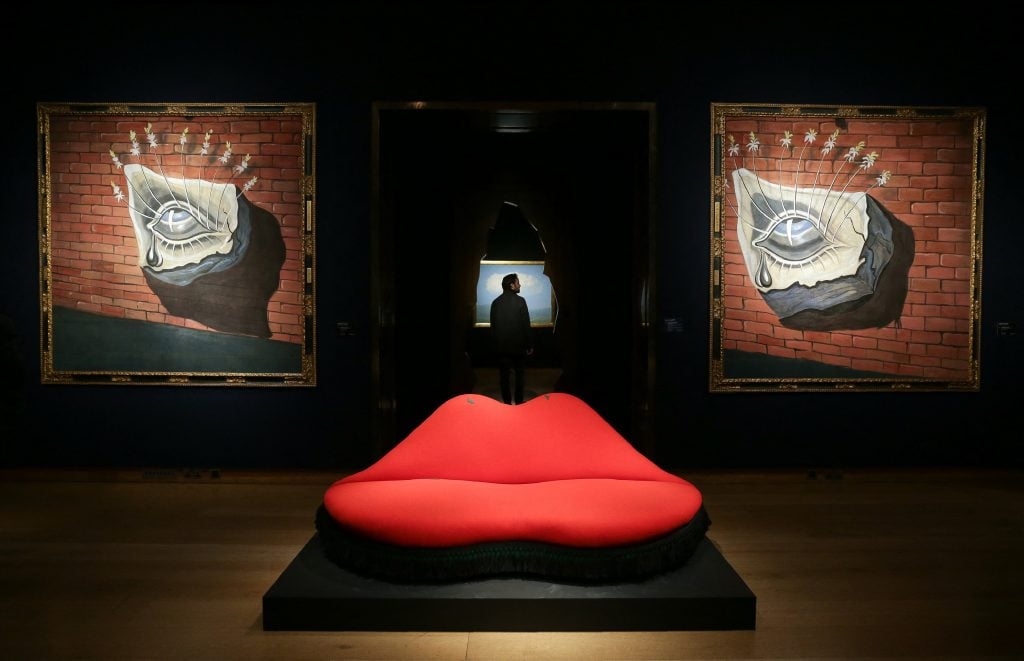
Salvador Dali’s Mae West Lips Sofa in front of L’oeil fleuri, décor pour le ballet Tristan fou at Christie’s in London, 2017. Photo: Daniel Leal/AFP via Getty Images.
French Surrealist husband-and-wife duo Les Lalanne (Claude and François-Xavier Lalanne) have seen a boom in market interest since the latter’s death in 2019, with their functional sculptures combining traditional furniture with exquisite design. Their famous series of life-sized sheep sculptures double as benches. Their works are handcrafted, displaying the quality and individuality of high art, yet they were always intended to be touched, sat upon, and ultimately enjoyed. While these pieces have been used functionally over the year, that doesn’t stop collectors from paying high art prices for them; a giant rhinoceros desk made by François-Xavier in 1964 sold for around $19.8 million at Christie’s in 2023.
While the market is currently hungry for Les Lalanne’s pieces, curator Paul B. Franklin told Artnet in 2024 that auction houses have some way to go in embracing such works as art in their own right, often still placing them within design and decorative art sales. “If we’ve learned anything in the 20th century, we’ve learned that those categories are corrupt, and I think Les Lalanne are really lovely encapsulations of how they no longer work. Why are we still so wedded to shoehorning everyone into the same train?”

François-Xavier and Claude Lalanne. Photo: Bruno Barbey. Credit Magnum Photos. Courtesy Sotheby’s.
Furniture as Body
Furniture is often used within art to reflect the presence or absence of the body. A boom of feminist artists in the 1960s and 70s, including Nicola L and Alina Szapocznikow, combined the body with items of furniture to explore domesticity, objecthood, and sexual liberation. More recently, Sarah Lucas has used items of furniture to create tongue-in-cheek works which play on sexual innuendos that degrade the female body. Her 1995 work ‘Bitch’ dresses a table in a t-shirt with two breast-like melons hanging from the front, evoking a woman on her hands and knees. Anna Uddenberg similarly drapes bodily sculptures across functional forms to horrifying effect. Previous works have seen hypersexualised female figures being swallowed by massage chairs or contorted across a hybrid entanglement of airport furniture, office items, and sex toys. The furniture in these works does not invite us to engage with it, but presents a terrifying entanglement of the body and an inanimate object.

Press preview at the British Pavillion with work of artist Sarah Lucas for the 56th Venice Biennale on May 5, 2015 in Venice, Italy. Photo by Awakening/Getty Images.
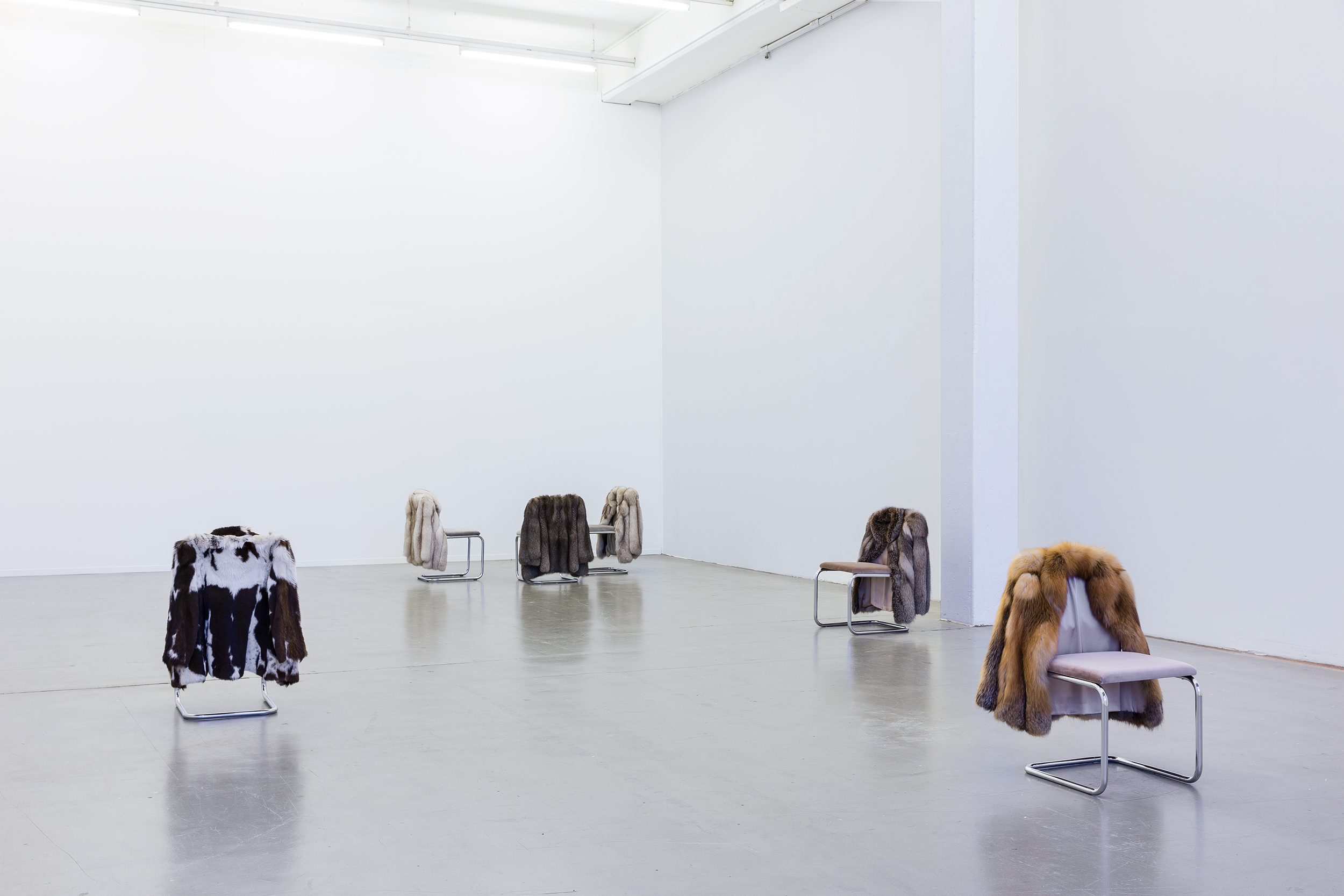
Nicole Wermers, whose solo show has recently opened at Lismore Castle, suggests the presence of the body through sculptures of women that sit atop corporate furniture or coats that drape across the back of chairs. “Furniture connects our bodies to the architecture around it, so it becomes this structural element that can be used to represent both body and space,” said Wermers in an interview. “The modified up-folded café tables I used as the display for my Marathon Dance Relief at Lismore Castle Arts have appeared in various forms and orientation several times in my work. You find these tables on the outside of cafes and restaurants where public and private space is constantly being negotiated.”
Wermers is very specific in her use of design, reflecting highly evocative cultural signifiers, from Marcel Breuer’s 1928 Cesca chairs to office cleaning trolleys. “I think about furniture and its design as among the constructions that underpin our social interactions, rituals and behaviour… The Breuer chair I chose for its aesthetics, but also because I liked the gesture of appropriating a chair designed by one of the great male modernist architect-designers (who was, just like Mies van der Rohe and Le Corbusier frequently collaborating with female designers, the contributions of which were hardly acknowledged during their lifetimes) with feminine coats.”

Installation view of “Sophie von Hellermann: Moonage” at Pilar Corrias in London until March 22, 2025. Photography: Ben Westoby, courtesy the artist and Pilar Corrias, London.
Breaking Beyond Painting
British artist Sophie Von Hellerman applies the same treatment to traditional canvases and practical items. In late 2024, she opened ‘Moonage’ at Pilar Corrias, applying her characteristically wild brushstrokes to the wall and canvases, as well as chairs, floor-to-ceiling curtains, lampshades, and screens. Her nods to interior space evoked the internal experience of the subconscious, inviting the viewer to lose themselves amidst images of entangled lovers, starry skies, and abundant plants.
“Covering the lampshades with images made them like projections of the subconscious,” said Hellerman in an interview. “I wanted to have chairs in the exhibition mainly because I was worried about where my parents could sit. I paint on things to ‘fix’ them. So instead of upholstering a chair, I paint on it, and then when I already have a paint brush in my hand, I might as well paint a picture.”

France-Lise McGurn’s “Strawberry” exhibition included her paintings and artist-made furniture. Courtesy of Massimo De Carlo.
France-Lise McGurn also paints beyond the limits of the canvas. In her 2024 exhibition ‘Strawberry’ at Massimo De Carlo in London, she placed an unconventional set of chairs in the gallery space, which seemed to simultaneously invite viewers to sit down and block them from doing so comfortably; three chairs joined at the front of their seats were shown in the middle of the room. Her unique hand-painted glass side tables were available to buy through House of Voltaire following her 2023 installation which reimagined a domestic space “tinged with the minds and musings of recently departed party guests.”
“My work is so much about intimacy and relationships so the furniture, I hope, encourages people to sit down,” she said in an interview. “It’s a way for people to feel intimate and close to the work, get physically ‘into it’. Those pieces in ‘Strawberry’ were very sexual I think, like if chairs were screwing each other, perfect readymades.” She doesn’t create a clear distinction between exhibition context and domestic use when it comes to her furniture. “I’m not really thinking about exhibition-making when I’m working. I’m really happy if they are in a domestic space, and I approach making them just the same as anything else. I don’t want things to feel precious, it’s such a mild rebellion to paint on any surface. Come and sit on the work, get personal with it.”
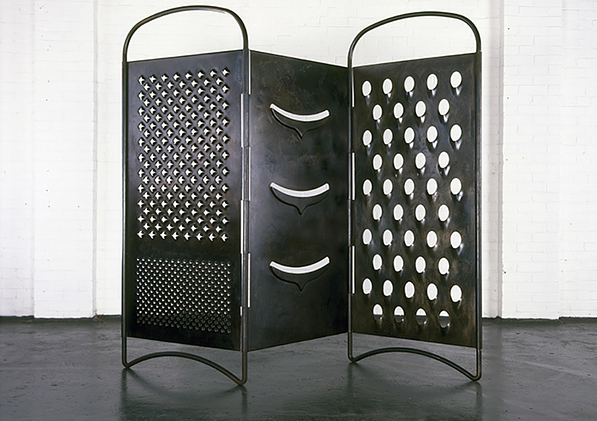
Mona Hatoum’s Grater Divide (2002), featured on the IAIA website.
Furniture as Threat
Conversely, Mona Hatoum contrasts the practicality and containment of furniture with terror and pain. She has previously reimagined beds and mattresses to reflect the horror of physical or psychological torture and social control, with traditionally restful structures re-formed as giant cheese graters or coffin-like metal boxes. Her pieces feel cold in the white cube gallery space, often using the hard structures and frames of furniture, rather than soft furnishings that invite touch and comfort.
Dozie Kanu likewise has leaned into the dark potential of furniture. In his 2018 work ‘Electric Chair’, hand-carved marble and leather convey the component parts of a murder device. Many of his pieces are comprised of multiple elements, whose functional role has changed in their placement together. There is also humor and playful disobedience to his unconventional use of practical objects. Precious Okoyomon, in a 2024 interview with Kanu described his furniture pieces as “a real act of love and everyday care”. “I would say there’s some generosity involved,” he replied. “This object I made has the potential to pragmatically serve; don’t crown it an amazing sculpture.”
Furniture provides a thread between our tangible lives and the illusory space of the gallery. The use of everyday furniture in art heightens the surreal nature of the exhibition space and brings with it a host of social and cultural signifiers to be subverted or exaggerated. These works allow the imagination to break past its confines, smashing the barrier between what we might call reality and the limitless space of art.
link